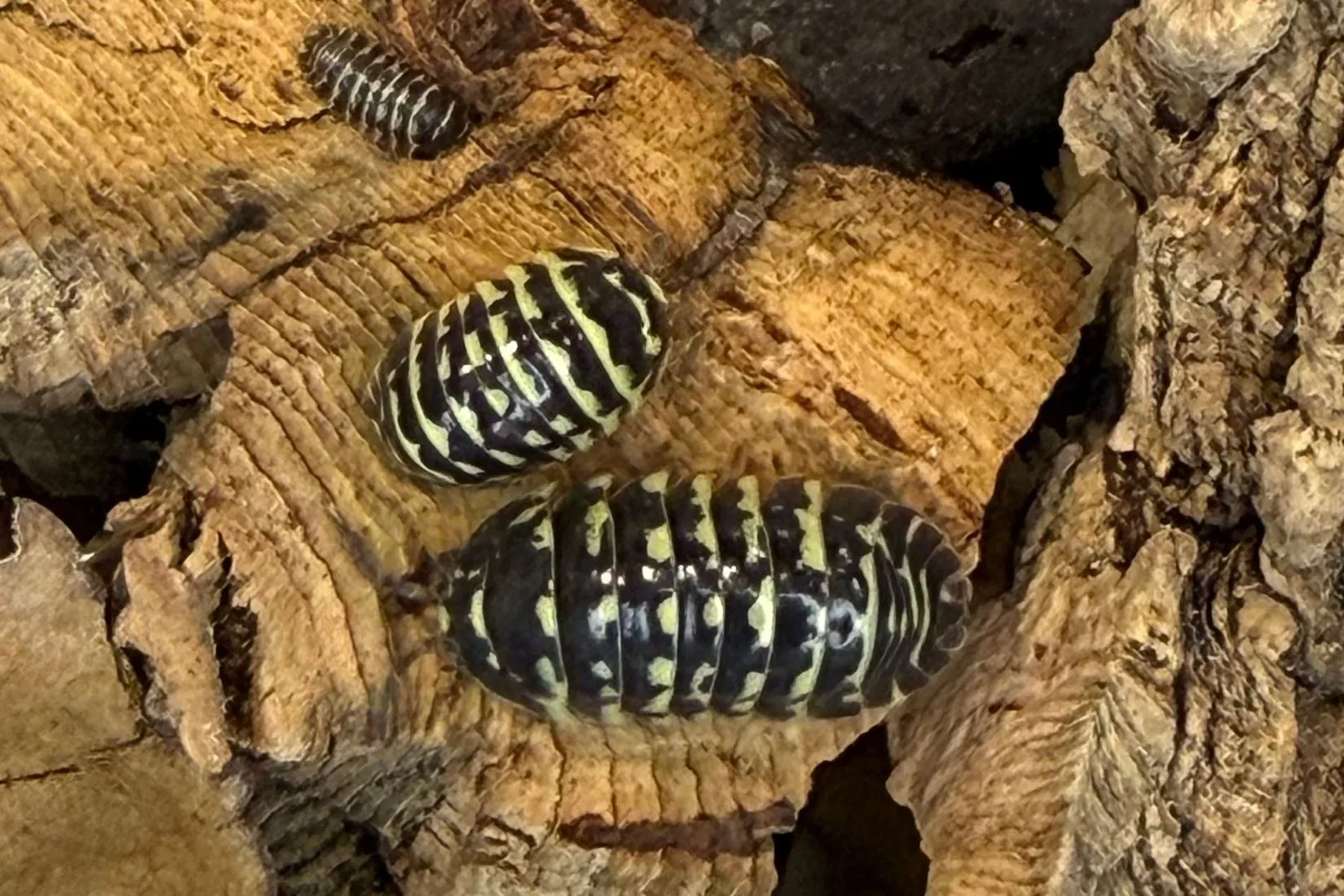
Yellow Zebra Isopods
Armadillidium maculatum "Yellow Zebra"
Bold yellow-and-dark banding on a pill bug that rolls into a ball: a striking display species.
$27.00
Low stockCulture size
Ships to the contiguous US, Alaska and DC, except Florida (permit restriction). Not to HI, PR, GU, VI, AS, MP.
Live-Arrival Guarantee
If more than 10% of your culture arrives dead, tell us within 12 hours of delivery (with photos) and we replace or refund every dead animal.
See shipping & guarantee for how claims work.
USDA APHIS permitted shipper
We ship under federal PPQ 526 permits, and only to states they allow for this species.
Our permit numbers: isopodpatch.com/permits
Free 3D figurine with every order
Patch the Isopod, our 3D-printed mascot, ships free in every box, printed the same day as your order.
Difficulty
Beginner
Adult size
12–18 mm
Temperature
65–80 °F
Humidity
45–65%
Breeding
Moderate
Role
Display
About
Meet the Yellow Zebra
Armadillidium maculatum, the zebra isopod, is one of the most eye-catching pill bugs in the hobby, and the "Yellow Zebra" form trades the usual white bands for warm yellow ones across a dark shell. Like other Armadillidium, it rolls into a ball when disturbed.
Originally from the Mediterranean coast of southern France, A. maculatum is considered hardy and easy to keep. It prefers a relatively dry surface with damp retreats (roughly half moist, half dry), moderate ventilation and calcium for its banded shell. Adults reach up to about 18 mm.
Your culture arrives snug in damp paper towel with juveniles and young adults. Every order is covered by our live-arrival guarantee and includes Patch the Isopod, our free 3D-printed mascot figurine.
Husbandry
Care snapshot
Substrate
Diet
Native range
Keeper notes
First week
- Keep about half the surface dry and half moist, with moderate ventilation: don't soak the whole enclosure.
- Mix a calcium source (crushed limestone or cuttlebone) into the substrate from day one.
- Give them plenty of leaf litter: zebras eat a lot of it.
- Breeding is moderate, so expect few babies at first: an undisturbed colony builds up over the following months.
In your box
What you'll receive
6 healthy, captive-bred animals of mixed sizes (6-count culture)
A snug, escape-proof cup with pin-sized air holes and damp, plant-free packing for the journey
Triple-packed in a styrofoam-insulated box, with a heat or cold pack when the weather calls for one
Our permit number, the APHIS Environmental Awareness Letter and a handling & disposal card
Live-Arrival Guarantee on every order
Patch the Isopod, a free 3D-printed figurine
Yellow Zebra Isopods: common questions
Where do zebra isopods come from?
Armadillidium maculatum comes from the Mediterranean coast of southern France. "Yellow Zebra" is a captive-bred color form with warm yellow bands instead of the usual white ones.
How big do zebra isopods get?
Adults reach up to about 18 mm.
Are zebra isopods easy to keep?
A. maculatum is considered hardy and easy to keep. Give it a relatively dry surface with damp retreats (roughly half moist, half dry), moderate ventilation and calcium for its banded shell.
How fast do zebra isopods breed?
Moderately. Expect few babies at first: an undisturbed colony builds up over the following months.
What do zebra isopods eat?
A steady supply of decaying hardwood leaves (zebras eat a lot of it), plus white rot wood, vegetables, occasional protein and calcium.
Can you ship Yellow Zebra isopods to Florida?
No. Florida's state review of our permit application asked APHIS to deny this species, so our Florida permit leaves it out. We ship Yellow Zebra everywhere else our permits cover. Check your state.
Cross-sell
Pairs well with
Keep browsing